
 Instructor: Lorilee Beltman
Skill Level: Advanced Beginner
Knitters must be comfortable working knitting, purling and following pattern directions. Prior experience with charts and cabling is helpful but not necessary.
Description:
Do you love gorgeous cable knits? Do you find that working cables slows you down a lot? Even if you are new to cable knitting, this class is for you. We will learn how to cross those cables in various configurations without the assistance of a cable needle.
If you learn this technique you can cut out that step where you have to look up the text translation of the charted symbol. Imagine cabling without having to glance over at the words all the time. You may even introduce fewer errors as you work.
A tidy appearance is important, too. In your ribbing and cables have you noticed that the left-most knit stitch looks sloppy? We will learn why it happens and then teach that stitch to behave!! Class also includes tips for keeping track of when it’s time for that cabling action row.
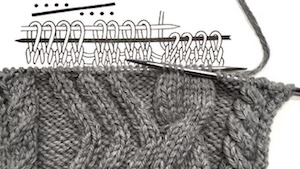
What we’ll learn is nothing new to knitting. The photo accompanying this course description is an illustration from a decades-old Estonian knitting book. Fascinating!
Included in Class:
Supplies Needed:
Homework:
Rows 1 and 3 (RS):
(P3,k2) twice, (p3,k4) twice, (p3,k6) twice, p3.
Rows 2 and 4 (WS):
(K3,p6) twice, (k3,p4)twice, (k3,p2) twice, k3.
Bring homework to class on the needles with yarn still attached
 Instructor: Beth Brown-Reinsel
Skill Level: Intermediate
Knitters must be comfortable with double-pointed needles. Working with Magic Loop or two circulars is possible, if necessary. The ability to knit English style (yarn held in right hand) is very helpful, but not required.
Description:
Watch Beth talk about this class on YouTube.
Curious about the 400 year-old Swedish technique of Twined Knitting? This unusual method of knitting produces a very warm, firmly elastic fabric and motifs not possible in any other type of knitting.
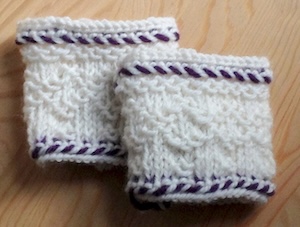
In this class, we will knit a pair of wristers while learning a traditional cast-on, twined knitting, twined purling and motifs that combine these such as the “O” stitch, the Crook stitch, and the Chain Path.
Learn how to manage your yarn so that untwisting becomes a cinch! Reading Twined Knitting charts will also be included.
Included in Class
Supplies Needed:
Homework:
 Instructor: Cecelia Campochiaro
Skill Level: Advanced Beginner
Knitters must be able to cast on, bind off, knit, purl, increase and decrease without help, and should be able to read their knitting. If you can make a 4×4 ribbing swatch without laddering, you will be fine.
Description:
Watch Cecelia talk about her Yarnover classes on YouTube.
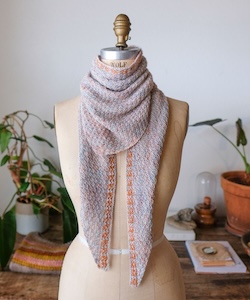
This is a project-based class to make a Winterview scarf or shawl. Winterview uses sequence knitting to create a beautiful textured triangle, and a woven slip-stitch pattern to create the decorative edging.
In class, we’ll discuss how to work the pattern, yarn quantities, and ideal yarn characteristics so you will be ready to cast on right after class.
The Winterview Scarf pattern is very flexible. It can be worked as a neckerchief using 400-450 yards of fingering or a large shawl using 700-900 yards of fingering. It works best with light weight (fingering) and drapey fibers. The sample was worked in an alpaca silk blend. Regardless of size, a small ball, fewer than 20 yards of contrasting color is needed. This can be the same weight as the main color or lighter weight.
Included in the Class:
Digital Winterview Scarf pattern (will be emailed approximately two weeks before class)
Supplies Needed:
Homework:
 Instructor: Romi Hill
Skill Level: Intermediate
Knitter must be able to read charts
Description:
Watch Romi talk about her Yarnover classes on YouTube.
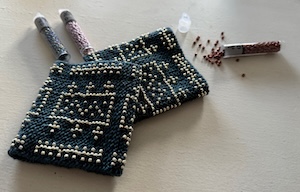
There’s colorwork with yarn, and then there’s colorwork with beads!
Beaded patterns can look subtle or flamboyant, and you can use different geometric or natural patterns without worrying about long yarn floats! Join me, Romi Hill, for a class on adding some bling or subtle beauty with bead patterning.
We’ll be talking about suitable beads, pre-stringing them, and knitting up a beaded swatch.
There is a $8 additional supplies fee, payable at registration, which includes enough beads for three swatches, a big eye beading needle for stringing beads, dental floss threaders for stringing beads and placing beads, and also superfloss for placing beads
Included in Class
Supplies Needed:
Homework:
 Instructor: Margaret Holzmann
Skill Level: Advanced Beginner
Knitters must have basic knitting skills, including a knitted cast-on, knit stitch and knitted bind-off. Familiarity with decreases (k2tog, ssk, cdd) and picking up stitches along straight and diagonal edges is helpful. All techniques will be demonstrated in class.
Description:
Watch Margaret talk about this class on YouTube.
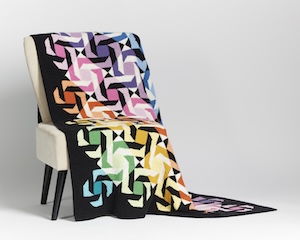
In Pinwheels, students will explore movement, color and structure through a playful yet sophisticated design featured in Margaret Holzmann’s book The New Color Work (December 2025.) This class dives deeper into geometric knitting by examining two different construction approaches for the same striking motif – offering knitters valuable insight into how design choices shape both process and finished fabric.
The Pinwheels pattern includes two construction options. One relies entirely on geometric, modular shapes, while the other blends geometric construction with a small amount of garter-stitch intarsia. In class, students will knit both versions of the motif, gaining hands-on experience with each method and learning how subtle changes in construction can dramatically affect the knitting experience and visual outcome.
As the pinwheel forms take shape, Margaret will guide students through the logic of modular, geometric assembly – demystifying complex looking designs and making them approachable and enjoyable to knit. By the end of the class, students will feel confident continuing on to knit the full blanket, with a clear understanding of how the pieces fit together and why they work.
In addition to construction techniques, Margaret will share practical guidance on choosing color palettes for knitted homeware projects, whether working from a curated yarn line or from stash. She will also present animated constructions of several of her blanket designs, offering rare behind-the-scenes insight into her design process and helping students develop a stronger design eye of their own.
Techniques Taught:
Geometric knitting methods, shaping, and garter-stitch intarsia to create the distinctive spinning pinwheel motif with minimal post-knitting assembly. Finishing techniques include duplicate-stitch weaving and mattress stitch for garter stitch, along with a demonstration of knitting backwards on wrong-side garter stitch.
Included in the Class:
Supplies Needed
Homework:
 Instructor: Bristol Ivy
Skill Level: Advanced Beginner
Experience needed: knitting, purling, increasing, decreasing
Description:
Watch Bristol talk about her Yarnover classes on YouTube.
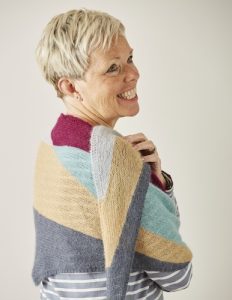
Intarsia often conjures up images of voluminous ‘80s sweaters covered in puppies, chicks and Laura Ashley florals. But the technique itself is super easy, super fun, and lends itself incredibly well to modern, linear, and graphic shapes. In this class, we’ll learn how to work intarsia flat, then how to shift stitches and even talk about how to work intarsia in the round.
Included in Class:
Supplies Needed:
Homework:
 Instructor: Brienne Moody
Skill Level: Advanced Beginner
Knitter should be comfortable casting on and binding off, able to knit and purl confidently, and understand basic knitting terminology. No prior design experience is necessary.
Description:
Watch Brienne talk about this class on YouTube.
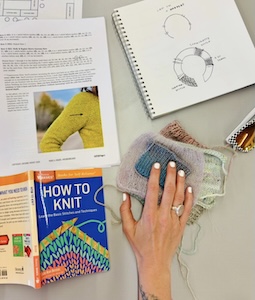
In this hands-on workshop, knitters will learn how to turn a simple swatch into the foundation for a well-fitting sweater. Students will explore how gauge, fabric characteristics, and body measurements work together to inform shaping and construction decisions.
We will evaluate purposeful swatches, accurately measure stitch and row gauge, translate body measurements into stitch counts, and begin drafting a personalized sweater blueprint. Students will learn how designers move from swatch data to schematic planning, and how those early fabric decisions impact fit and proportion.
Throughout the class, I will share sweater samples from my own design work and walk students through how the swatch-to-sweater process informed specific shaping and construction choices. This behind-the-scenes look will help students connect the math to finished garments and better understand how to apply these principles to patterns they knit or modify in the future.
Students will leave with practical calculation tools, a clearer understanding of sweater architecture, and increased confidence working within or beyond published patterns.
Included in the Class:
Supplies Needed:
Homework:
 Instructor: Laura Ricketts
Skill Level: Intermediate
Knitter must know how to cast on, decrease, knit and purl in the round, and do color work.
Description:
Watch Laura talk about her classes on YouTube.
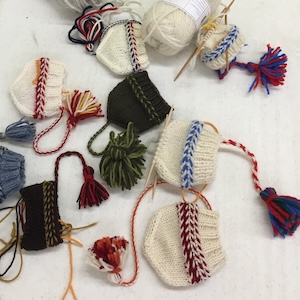
The Sámi are Scandinavia’s only UN-recognized indigenous people and have a culture rich with fiber traditions. In this class, students will be introduced to Sámi mittens and four characteristics which set them apart: cuffs, thumbs, decreases and braids (with or without tassels.)
We will create a sample swatch by practicing each of these elements and leave with the knowledge to translate our skills to a full-sized pair of mittens.
Included in Class:
Supplies Needed:
Homework:
Our spinning demonstrations are sponsored by Get Bentz Farm.
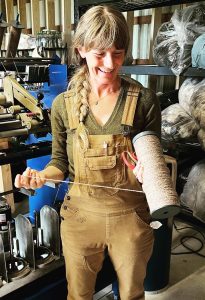 After growing up in the city and suburbs, the owners of Get Bentz Farm felt a need to be closer to nature and to be more connected to where their food came from.
In 2014, they found a farm house for sale and later that year they decided on and purchased their first two Icelandic sheep.
Once they had a good size flock they began marketing the amazing meat and wool. Initially, they found that many mills in the area do not process dual coated long wools, which slowed down their growth in yarn, but they did find a great market for wool filled bedding products and batting for spinning.
Today, they have a variety of yarns, batting and roving as well as finished products like dryer balls, sheepskins, and wool bedding. Most recently, they opened their own Get Bentz Wool Mill as well as their own line of yarn – Badgerface Fiber.